What happens when someone files a TradeMark similar to yours
The UK Trademark filing process
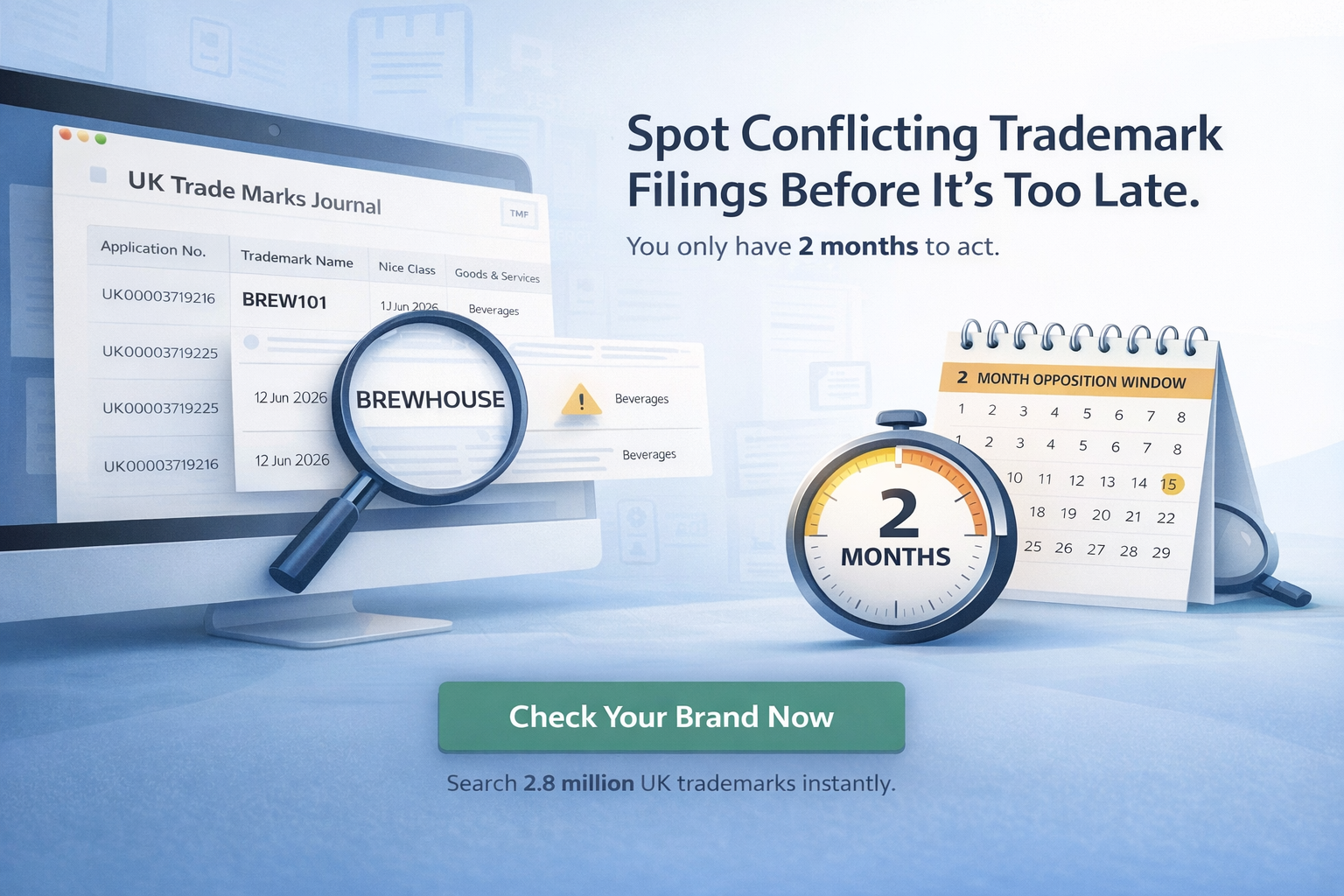
When a business applies to register a trademark with the UK Intellectual Property Office (IPO), the application goes through several stages. First, an IPO examiner checks it meets the basic requirements. If it passes, the application is published in the Trade Marks Journal — a weekly publication that lists every new trademark seeking registration.
This publication isn't just a formality. It's a legal notice. It's the IPO's way of saying: "We're about to register this mark. If anyone has a problem with it, now's the time to speak up."
The 2-Month Opposition window
Once a trademark application is published in the journal, a 2-month countdown begins. During this window, anyone who believes the new mark conflicts with their existing rights can file a Notice of Opposition using form TM7.
Two months might sound like plenty of time. In practice, it isn't — because most businesses never find out a conflicting mark has been filed in the first place.
The IPO doesn't notify you. There's no automatic alert. Unless you're actively monitoring the Trade Marks Journal every week, a conflicting application can sail through unopposed and become a registered trademark.
What "similar" actually means
A trademark doesn't have to be identical to yours to cause problems. The IPO and UK courts consider several factors when assessing whether two marks conflict:
Visual similarity — Do they look alike? Similar letter patterns, shared words, or comparable logos can all count.
Phonetic similarity — Do they sound the same when spoken aloud? "BREWHAUS" and "BREW101" might look different on paper, but they share the same opening sound.
Conceptual similarity — Do they evoke the same idea or meaning? Two marks that both reference the same concept can conflict even if the words are completely different.
Goods and services — Are the marks used in the same or related commercial areas? A clothing brand called "APEX" and a software company called "APEX" may coexist, but two clothing brands with similar names in the same Nice class will almost certainly clash.
What happens if you don't act
If a conflicting trademark is registered and you didn't oppose it during the 2-month window, your options become significantly more limited and expensive:
Cancellation proceedings — You can apply to invalidate the registration after the fact, but this is a longer, more complex process than opposition.
Negotiation and coexistence agreements — You might end up paying for a legal agreement to share the market, which can restrict how and where you use your own brand.
Rebranding — In the worst case, if the other party has stronger rights or is more aggressive in enforcement, you could be forced to rebrand entirely. Depending on the size of your business, this could cost anywhere from a few thousand to hundreds of thousands of pounds.
Legal costs — A contested trademark opposition typically costs £5,000–15,000 in legal fees. But if it escalates to cancellation proceedings or litigation, costs can reach £50,000 or more.
The common thread here is that every option after the 2-month window is harder, slower, and more expensive than filing a timely opposition.
The real problem: You don't know what you don't know
The IPO Trade Marks Journal is publicly available. In theory, any business owner can download it each week and check for conflicting applications. In practice, almost nobody does.
The journal is published as XML data. Each issue contains hundreds of applications. Checking whether any of them conflict with your specific trademark — across text, phonetic similarity, Nice classes, and goods descriptions — is a manual process that would take hours every week.
This is exactly the kind of task that should be automated.
How TMGuard solves this
TMGuard monitors the weekly IPO Trade Marks Journal automatically. When a new application is published that could conflict with your registered trademark, TMGuard:
Scans every new filing against your watched marks using five matching layers: text similarity, phonetic matching, Nice class overlap, goods and services analysis, and applicant tracking.
Scores each potential conflict on a 0-100 risk scale, so you can focus on the threats that matter most.
Alerts you in plain English with a clear explanation of why the match was flagged and what your options are.
Tracks your opposition deadline so you never miss the 2-month window.
We currently monitor over 2.6 million UK trademarks across the complete IPO register. Every week, when the new journal is published, our matching engine checks it against your watched marks within hours.
Check your brand now
Want to see if there are already trademarks similar to yours? Use our free brand check tool — no signup required! Enter your brand name and we'll scan 2.8 million UK trademarks instantly and show you the top conflicts.!